Body-Part Cope Ranked: How to Actually Make These Muscles Grow

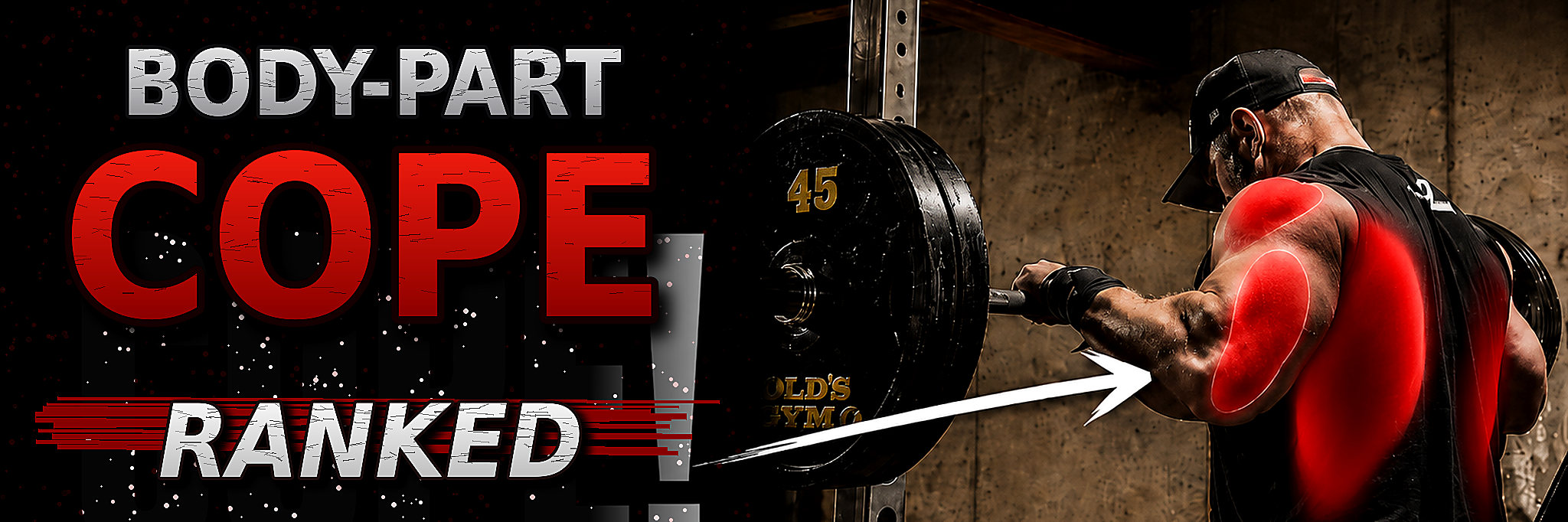
There are certain body parts that lifters love to train, and there are certain body parts that come with an endless list of excuses.
When it comes to chest and biceps, everybody suddenly understands the importance of effort, consistency, exercise variety, and progressive overload. Nobody has to beg lifters to attack the bench press or add another curl variation.
But when we start talking about the back, shoulders, triceps, calves, and traps, everything changes.
Suddenly, the body is fragile.
Suddenly, progressive overload is dangerous.
Suddenly, light weights and the mind-muscle connection are all that matter.
Suddenly, genetics become an impossible obstacle.
This is what I mean by body-part cope. It is the collection of excuses, fears, and weak training practices lifters use to justify why they are not attacking a muscle as hard as they could be.
Not everybody needs to prioritize every body part equally. That is not the point. The point is that you cannot train a muscle inconsistently, avoid getting stronger, use weak exercise selection, and then pretend you have discovered some biological reason why it refuses to grow.
Here are the five body parts that I believe come with the greatest amount of training cope.
1. Back
The back takes the top spot because it can handle an incredible amount of punishment, yet most lifters are far weaker on their back exercises than they should be.
Look around the average gym. You will see people grinding away on chest presses, loading up their leg exercises, and trying to add weight to their curls. Then they move over to back training and everything becomes cautious, slow, and weak.
The back is a massive collection of muscles. It is not some tiny, delicate body part that needs to be gently stimulated with endless lightweight sets.
It can take punishment.
It can handle hard training.
It can handle meaningful volume.
It can also become incredibly strong, but most lifters never come close to developing that strength.
One of the biggest issues is that people allow their grip to limit their back development. Their hands begin to fatigue, so the set ends even though the back could have continued working.
There is no award for refusing to use straps while your back remains underdeveloped. If your grip is preventing you from properly training your back, use straps and continue attacking the target muscle.
Grip strength is important, but your grip should not hold your entire back hostage.
There is also a tremendous amount of fear surrounding power generation. Lifters have been taught that every back exercise must be performed with an unnaturally slow tempo and absolutely no body movement.
This often turns a potentially productive exercise into a weak performance with very little progression opportunity.
There is a difference between generating controlled power and using reckless form. You should not turn every row into a full-body circus act, but you also do not need to move every weight like you are performing underwater physical therapy.
Attack your back training. Get strong on your rows, pulldowns, pull-ups, deadlift variations, and other quality back exercises. Use straps when necessary, generate controlled power, and stop treating the back like it cannot withstand hard work.
2. Shoulders
Shoulder training has become dominated by lateral raises.
Lateral raises can be useful, but there is an over-reliance on them even though they often provide limited opportunities for long-term progression.
People will perform endless lateral raise variations while doing everything possible to avoid overhead pressing. They will create every excuse under the sun.
Overhead pressing hurts.
Overhead pressing is not necessary.
Overhead pressing is dangerous.
Overhead pressing does not target the side delts enough.
Meanwhile, their shoulders remain weak and underdeveloped.
Even when shoulders are included in a program, they are often treated as an afterthought. Lifters might throw in a few lateral raises at the end of another workout and consider their shoulder training complete.
Then there is the fear-based cope. Many lifters behave as if the shoulders are made of glass and cannot tolerate intense training.
The shoulders deserve intelligent exercise selection and responsible progression, but that does not mean they need to be babied.
Pressing strength matters. You should be trying to improve your performance on overhead pressing variations that feel comfortable and natural for your body.
That might include barbell presses, dumbbell presses, machine presses, or other quality variations. The specific tool is less important than the effort and progression.
Lateral raises can remain part of your program, but they should not become a replacement for every other form of serious shoulder training.
Stop treating your shoulders like an afterthought. Give them their own focused work, attack progressive overload, and understand that intense training is not the same thing as reckless training.
3. Triceps
The triceps are another body part that can take a tremendous amount of punishment, much like the back.
Despite this, most lifters do not train their triceps with as much volume as they could potentially handle.
They might perform a couple of weak sets of pushdowns after chest training and then wonder why their arms are not growing and their pressing strength remains unimpressive.
The triceps make up a large portion of the upper arm. If you want bigger arms, they cannot be treated like a minor accessory muscle.
Exercise selection is another major problem.
A lot of triceps training simply sucks. Lifters select exercises that are easy, comfortable, and difficult to progress. They move the weight around, feel a small pump, and assume the job is done.
The training is rarely intense enough to force meaningful adaptation.
You need quality triceps exercises that allow you to train hard and improve over time. This can include presses and direct isolation work. The goal is not to find one magical movement. The goal is to build a group of productive exercises and attack them consistently.
Most people simply have weak triceps.
That weakness is not going to disappear through random pump work. It is corrected by training the triceps with enough volume, using productive exercise selection, and placing a real emphasis on getting stronger.
Train your triceps like they matter, because they do.
4. Calves
When was the last time you saw somebody in the gym training their calves with the same energy and focus they bring to chest training?
Calves might be the most inconsistently trained muscle group in the entire body.
Somebody will perform a few sets for a week or two, forget about them for a month, add them back into the program, and then complain that their calves refuse to grow.
There is no real consistency.
There is no sustained attack.
There is no patience.
You also rarely see any impressive display of calf strength or progressive overload online.
People post massive bench presses, heavy squats, big deadlifts, and impressive curls. Almost nobody is excited about building tremendous strength on calf exercises.
That tells you a lot about how calves are generally approached.
Even when calves are trained, there is rarely much exercise variety or frequency. A lifter might perform the same couple of sets on the same machine once per week and expect dramatic results.
Calves are not exempt from the principles that build every other muscle.
They need consistency.
They need progression.
They need enough frequency.
They need quality exercise variety.
You cannot train calves like an obligation and expect them to grow like a priority. Give them regular attention, use multiple productive movements when possible, and attack progressive overload just as you would with any other body part.
5. Traps
The traps can be trained with an incredible amount of weight, yet trap training is often lifeless, uninspired, and overly weak.
Nine times out of ten, you see an over-reliance on slow, lightweight, mind-muscle-connection training.
Lifters grab a weight that offers no real challenge, move it slowly, squeeze at the top, and convince themselves they are protecting their joints or creating a superior contraction.
Meanwhile, there is no serious attack on progressive overload.
The traps are built to handle heavy loading. That does not mean you need to perform ugly, uncontrolled reps, but it does mean you should stop being afraid of challenging them.
Trap training should involve effort.
It should involve weight.
It should involve progression.
It should look alive.
There is nothing wrong with controlled repetitions or focusing on the target muscle, but the mind-muscle connection cannot become an excuse for using the same light weights forever.
Your traps are not going to reach their potential through uninspired training. Select productive exercises, load them responsibly, and work to become brutally strong over time.
Stop Creating Excuses and Start Creating Progress
The common thread with all five of these body parts is not a lack of secret exercises.
It is a lack of attack.
Back training is limited by weak effort, grip fatigue, and fear of power generation.
Shoulder training is reduced to endless lateral raises while overhead pressing is avoided.
Triceps are undertrained, poorly trained, and generally weak.
Calves receive almost no consistency, variety, frequency, or serious progression.
Traps are trained with lifeless weights and very little ambition.
You do not need to train recklessly. You do not need to ignore pain, limitations, or intelligent exercise execution.
But you also cannot hide weak training behind scientific-sounding excuses.
Pick quality exercises. Train them consistently. Add strength and reps over time. Give each muscle enough focused work to create a reason for it to grow.
The body part with the most cope is usually the body part you have created the most excuses not to attack.