The 7 Major “Big Back” Rules - Do They Hold Up?

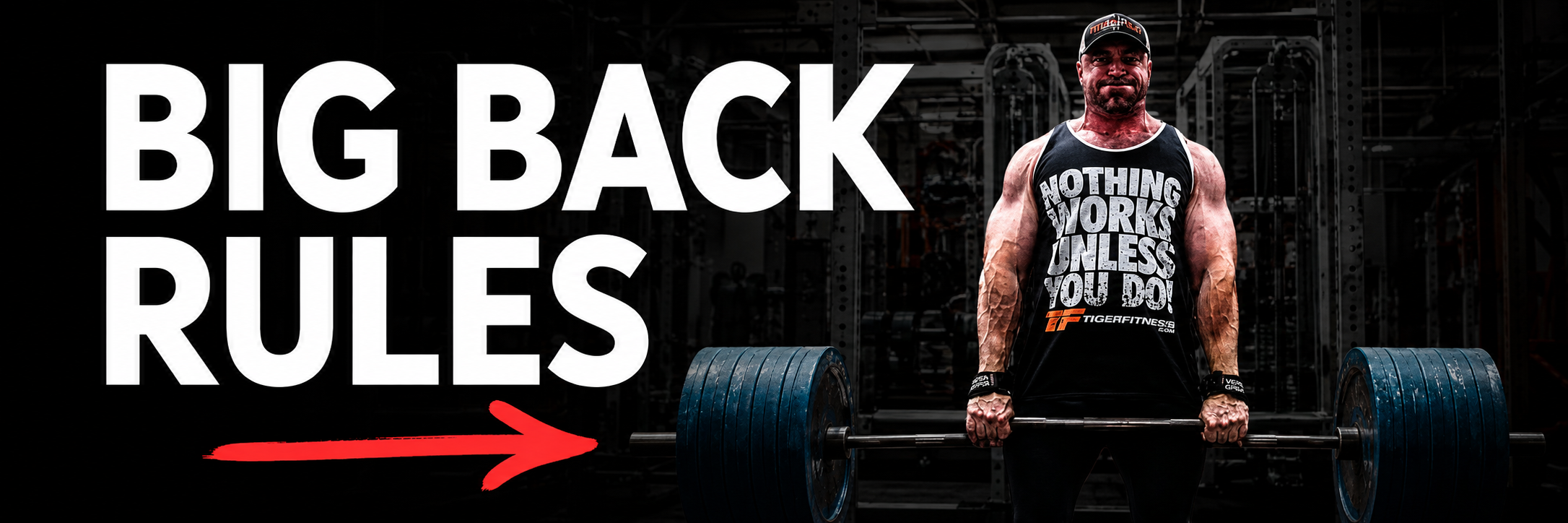
Building a big back can feel like a complete puzzle. I've seen so many rules tossed around, and these rules can often be confusing, contradict another rule, or they simply don't often work in the real world for lifters like you and I.
Here are some examples:
You must do twice as much pull work as you do push work
Basically this means you need twice the number of sets for back as you do for chest.
Obviously, this falls apart for a number of reasons. If you work the chest to a reasonable degree each week, say with 10 to 12 sets, applying this rule you'd have to work 20 to 25 sets for back each training week - that's roughly 2 hours of gym time.
This means you either need to live in the gym, or chop a bunch of things from your weekly training routine to the point where it isn’t enjoyable.
You shouldn't wear lifting straps during back work - it encourages a weak grip
If you follow this rule your back development will be limited by your grip. Does that make sense? Are you trying to become the world's strongest gripper? Or are you trying to build a big back?
Never let a weak body part slow the development of a bigger body part. What sense does this make? If your grip is subpar, work it later in the workout or training week.
I don't know about you, but when I'm moving around heavy weight during back training I dislike worrying about my grip. It's distracting and takes me away from focusing on working my back. Instead of trying to connect with the back feel as I drive my elbows to move the weight, I'm laser focused on my weakening or slipping grip.
The deadlift isn't a back exercise
The deadlift is in everything exercise. It's an incredible compound movement that calls into play many muscle groups. With that said, it's not simply a standing leg press. While your quads are certainly working during a deadlift, the deadlift is not primarily a leg builder.
More than any other area, deadlifts tax the upper back and yoke. The very act of pulling a heavy barbell off the ground and holding it into place while you drive your head up towards lockout places an incredible amount of stress on your traps, lats, and muscle groups of the upper back.
The deadlift is a wonderful back builder. I've met many experienced lifters during my years that have echoed this same sentiment.
Unfortunately, many lifters want to turn every topic in the training world into a black or white scenario. Just because the deadlift works the back doesn't mean it's not working other areas of the body. It's not an either or situation.
It's a both situation, but it's a situation where we know for certain that the deadlift is going to help you build a much bigger back.
You must do pull-ups or else you’ll never build a big back
This is simply untrue. During my time in coaching I quickly came to realize that the majority of lifters struggle with pull-ups, meaning anything beyond 3 to 5 reps seemed like a dream.
Now, I'm not trying to discourage you from working on your pull-ups. Far from it. With that said, we have to ground our back training in the real world and not in a fantasy world.
Making up arbitrary rules like this does nothing but discourage lifters from training hard on other lifts. It's also narrow-sighted and idiotic.
I would argue that there are more quality back exercises than there are quality lifts for any other major body part. T-bar rows, barbell rows, Yates rows, seated cable rows, chest supported rows, dumbbell rows, Meadows rows, inverted rows, seal rows, machine rows, lat pull downs, dumbbell pullovers, and pullover machine.
You get the picture.
With all these available tools, do you really feel the world is going to end if you don't - or can’t - do pull-ups?
You must do an equal amount of horizontal and vertical pulling
Again, we're staring down the barrel of an arbitrary rule. This rule tries to equate vertical pulling, which includes pull-ups and lat pull downs, to horizontal pulling or rowing, which basically includes about 10 or more incredibly effective and potent row variations.
The fact of the matter is, there are far more quality rowing movements than there are vertical pulling movements. This isn't an opinion. It's reality.
But somehow, in our small insect brains, we want everything to be nice and tidy, meaning a 50/50 ratio of vertical to horizontal pulling.
We've already covered the fact that pull-ups can be a challenging movement for most individuals. Again, this is not a reason to avoid them but you certainly don't need to do them to build a big back.
The other major vertical pulling movement is the lat pull down. This is a fine exercise, but the fact of the matter is this: after a couple years of hard training, progression will slow dramatically on this movement and you will pretty much reach a soft cap on weight additions.
So with lat pull downs not having the best progressive overload profile, and with pull-ups being a struggle bus exercise for many, this leaves us with horizontal pulling and rowing to fill in the gaps.
If we want to build the most potent, brutal, and impactful back building workout we must use the exercises that are challenging us even if they don't fit into some arbitrary 50 /50 ratio.
In fact, I want to encourage you to set the whole 50/50 ratio aside and forget you ever heard about it. Do your pull-ups if you like them. Hit your lat pull downs knowing that if you're training hard they will eventually slow pretty dramatically, and fill in the rest of your time in the gym with challenging rowing exercises.
Exercises are either back width or back thickness
This is a very confusing principle that does a good job of positioning each back exercise as being capable of only one outcome. Like somehow a barbell row can only create back thickness and not back width.
Do you see what's happening here? We're trying to turn compound exercises into isolation exercises, framing them as having only one area of focus.
If you are crushing heavy weight on your barbell and dumbbell rows you are going to work your lats to a degree. This isn't something we need to argue about; meaning going to war over the question: “Just what specific impact do rows have on the lats.” They have some. It’s not zero.
We are not trying to create scientific formulas here; we're trying to build a bigger and stronger back.
In the Massive Iron world we use a very simple principle: focus on attacking a muscle group with a quality, impactful variety of movements. Basically, bring your biggest guns to battle and go to war.
Do we really need to know to what degree a dumbbell row hits the lats compared to the other areas of the upper back? No. But we certainly can't act like a dumbbell row is an isolation exercise that only creates back thickness and doesn't contribute to back width.
In the bodybuilding world though exercises are framed as back width exercises or back thickness exercises. This is certainly an okay tool if you look from a broader perspective.
Just understand that back development is far more complex than this. Also understand it's nothing you really need to be concerned about as long as you have a quality selection of exercises that involve whatever vertical pulling and horizontal rowing movements you feel work best for you.
For you. I stress that a second time.
Deadlifts are a must for back development
Deadlifts are optional for a big back.
This is not a popular sentiment on the internet, but it is true. When it comes to form, the deadlift is very nuanced and can take years to master. During this time, if you attack the deadlift too aggressively you'll likely experience a lot of lower back discomfort.
These lower back issues might even keep you out of the gym.
In the modern muscle building world deadlifts can be pushed very aggressively. Understand that this can be a huge mistake for many lifters. No, I'm not telling you to avoid the deadlift. It certainly is a great back developer.
Just understand that you need to give the deadlift time. You need to give yourself time to work on form while not aggressively attacking progressive overload. If your lower back feels good then slowly add weight. But if you aggressively add weight before you understand proper form, it will result in a lot of unwanted lower back stress.
I've worked with enough clients to know that for some lifters the time involved in learning deadlift form is simply not worth it. I only mention this because I want you to understand that if this is you, it's okay to set the deadlift aside.
You can still build a big back without it. There are too many big gun back exercises available for this to not be the case.
Take Home for Back Development
Make a list of impactful back exercises that you enjoy, and that fit your available equipment.
Perform deadlifts and pull-ups if you like them.
Set aside any back exercises that tear up your lower back.
Don't waste much time thinking about back width and back thickness exercises.
Use lifting straps or Versa Grip Pros - they will help your back training and help you to avoid elbow tendonitis which is an overuse injury generally driven by all the grip work we do on back day.
Focus on about 10 to 12 sets for back each week, and about 12 to 15 if you deadlift. This is not meant to be a rule but rather a good starting point.